
History
HISTORY
Croatian Sports Centre Gold Coast is the heart of Croatian culture on the Gold Coast, offering a welcoming place for all “Croat Australians” to gather for the love of food and soccer. As the club has grown, so has its impression on the entire Gold Coast community. Today, Gold Coast residents of all backgrounds enjoy dining at the centre – cheering on their teams and hosting special occasions there.
The club’s origins began more than 40 years ago, on April 16, 1982, when 146 Croatian migrants purchased land in the heart of Carrara. A small clubhouse was built first, and that would soon become home for the Gold Coast Knights Football Club (then named St. Anthony’s Soccer Club, with the club house called Croatian Australian St. Anthony’s Sports Centre Club).
The Centre was also established as a place where new Croatian migrants and Australian-born Croatians could come together. Founders and their families would soon refer to the Centre as a second home, and that sentiment describes exactly how second and third generation Australian-Croatians feel about it today, decades on.
History through the decades
1960s
Since the late 1960s, Croatian people have gathered on the Gold Coast. They often joined Brisbane’s Croatian community at Morningside for mass and helped with the refurbishment of the Croatian club there.
1970s
In the late 1970s, the Croatian community on the Gold Coast was sizeable enough for a Croatian priest to travel to the St Joseph’s Workers Church at Labrador (north Gold Coast) to deliver his sermon. Croatian dinner dances (zabavas) were commonplace, held at the Southport RSL.
In 1978, a handful of men, who were homesick for their Croatian football culture, met for an important discussion. The idea for a soccer club was created. St Anthony’s Croatian Soccer Club (now Gold Coast Knights Football Club) took to the field the following year, in 1979. The junior teams played at Aquinas College, Ashmore.
1980s
In 1980, the soccer club would also hire fields at Keith Hunt Park, Labrador, where the over 35s teams would play for two years.
Meanwhile, the Gold Coast’s Croatian migrant population was growing. So too, was the soccer club. The club’s ancestors decided they needed their own “home”, so they raised and cumulated their funds to buy 2.985ha of vacant land for $115,000 at Carrara. They built a small clubhouse, and two soccer fields were laid, with lighting on one field.
To fund construction of the first clubhouse, a small loan was taken out with the balance being funded by donations and the introduction of foundation memberships.
1990s
By 1990 the club had outgrown its premises, and the current clubhouse was built to replace it. Foundation members each chipped in $1000 of their own money. However, the completion of the clubhouse experienced delays due to the Homeland War in Croatia. There was conjecture about whether building works should continue, or whether the land should be sold, and the profits sent to Croatia. The decision was made to complete the build. Today’s members are grateful for the drive and resolve of the members who were determined to complete the project.
In 1995, the Centre hosted the annual Croatian Soccer Tournament of Australia and New Zealand for the first time.
2010s
On June 17, 2016, the name Croatian Australian St Anthony’s Sports Centre officially changed to Croatian Sports Centre Gold Coast Incorporated.
In 2012, the Centre hosted the annual Croatian Soccer Tournament of Australia and New Zealand. Croatian Centre Gold Coast was used as the main venue, in addition to the Alabaster playing fields at Carrara. Due to the tournament’s success, the club turned the gravel 200-capacity car park into a bitumen car park.
In 2018, the Centre again hosted this tournament, and the club was able to clear all debts and become unencumbered. This was an extremely important moment for the club’s community, and a milestone that will always be looked back on proudly.
Prior to this, in 2017, construction began on a Roman Catholic chapel, onsite next to the clubhouse. In February 2019 St. Leopold Mandic Chapel officially opened, offering a further venue to host Roman Catholic christenings, weddings, funerals, and regular masses.
2020s
Community
In 2023 the Centre has, or is, home to many associations including Gold Coast Knights Football Club, Gold Coast Knights Old Boys, Gold Coast NK Adriatic, GCK Croatian Social Golf Club, St Leopold Mandic Chapel, Australian Croatian Pensioners Club Gold Coast Inc, GCK Croatian Social Golf Club, and traditional folkloric dance group HFS Velebit Gold Coast. It is the permanent base of the Gold Coast Knights Football Club and St Leopold Mandic Chapel.
The centre also opens its doors as a meeting place for the whole Gold Coast community, groups, businesses, and individuals who would like to join as members, or host functions at the venue.
Memberships
Prior to July 2021, the constitution had one layer of memberships and only unofficially recognised its foundation members. To reflect the history of the club, and to steer the club to a sustainable future, the committee passed a new constitution in July 2021 to officially recognise foundation members. They also introduced three extra levels of membership: perpetual, ordinary, and social.
Events
Croatian Sports Centre Gold Coast has been utilised by more than 3000 players in a 40-year period. It is the Croatian community’s second home – used for happy occasions, and sad times when individuals need people around them.
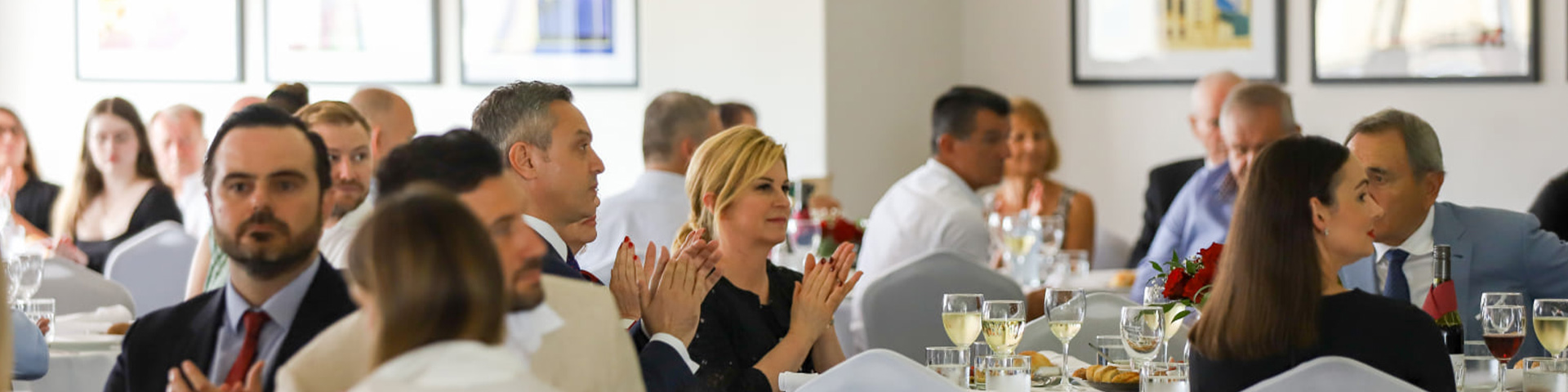
Along with weddings, the clubhouse hosts Gold Coast community events like multicultural celebrations, boxing events, conferences, dances, and weddings.
Food
The centre’s in-house specialty chefs also prepare quality food for breakfast, lunch, or dinner (open on occasion, and often throughout the soccer season).
Foundation and Committee
While the club has always had management committees, it previously ran on the goodwill of volunteers who helped work the kitchen, bar, grounds, or any other areas. As times have changed, the club has progressed to rely on fewer volunteers and is run by a full-time club manager and staff. The club is still supported by a management committee of volunteers which consists of (at a minimum) a President, Vice President, Secretary, Treasurer, and Football Manager.
A permanent honour board is on display in the clubhouse, acknowledging the 146 founding members who worked tirelessly to establish the football club and its facilities. While some members have passed, most are still active club members and regular game supporters.